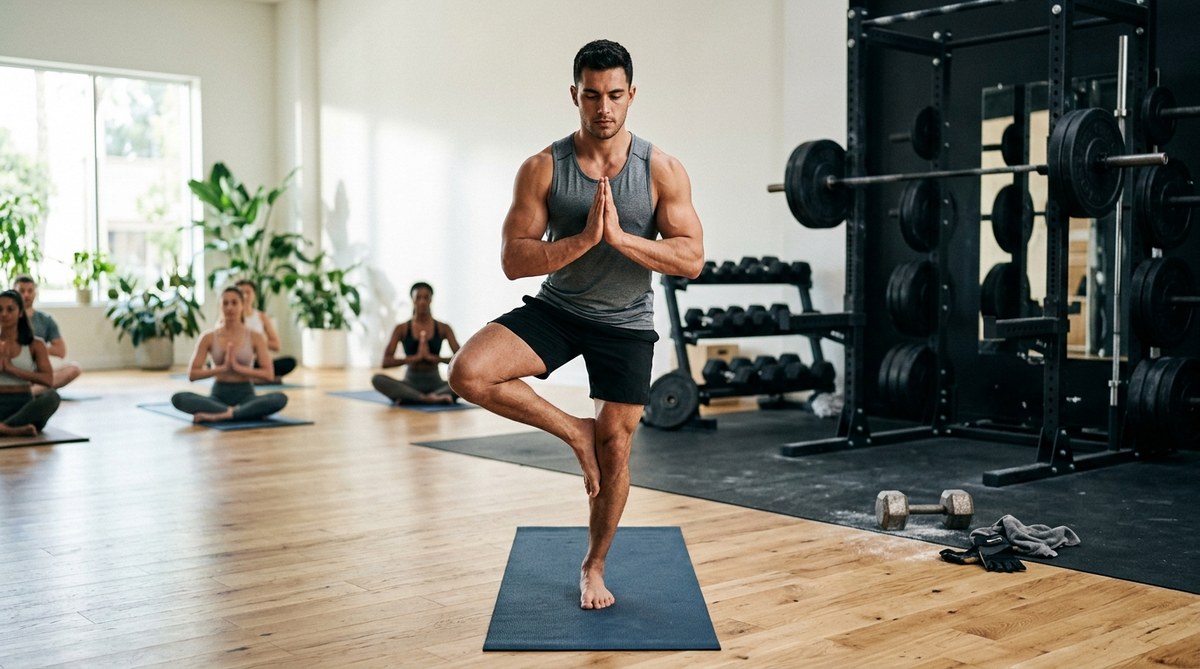
The clang of iron plates is being replaced by the soft hum of guided breathing. Walk into any high performance training center in 2026, and you’re just as likely to see NFL linemen holding a downward dog as you are to see them bench pressing 300 pounds. It’s not a fad. It’s a fundamental shift in how athletes view strength, recovery, and longevity. They are trading weight rooms for yoga mats, and the results are turning heads.
Athletes from the NBA to the UFC are swapping heavy barbells for yoga mats to reduce injury rates, improve mobility, and sharpen mental focus. Yoga builds functional strength without pounding joints. It also accelerates recovery between games. This trend is not about abandoning weights entirely but integrating yoga as a core component of modern athletic training in 2026.
The Shift from Iron to Inner Peace
For decades, the weight room was the undisputed temple of athleticism. Bigger muscles meant better performance. But a wave of research and real world results has shown that raw bulk isn’t everything. Today’s athletes face longer seasons, faster game speeds, and greater demands on their bodies. The old school approach of constant heavy lifting is giving way to smarter training that emphasizes mobility, stability, and nervous system recovery.
Yoga offers a unique blend of all three. It lengthens muscles that weights tighten. It teaches athletes to control their breath under physical duress. And it builds the kind of core strength that prevents the back and hip injuries that plague so many careers. As a result, the image of a meathead grunting through reps is being replaced by a leaner, more agile athlete who moves like a dancer and hits like a truck.
Why Yoga Beats the Barbell for Longevity
Let’s look at the numbers. A 2025 study published in the Journal of Strength and Conditioning Research found that athletes who practiced yoga twice a week reduced their injury risk by 34 percent compared to those who did only traditional resistance training. The reason is simple: yoga addresses the imbalances that weightlifting often creates.
- Improved range of motion: Tight hamstrings and hips are the #1 cause of pulls and strains in most sports.
- Better joint health: Yoga lubricates the joints through controlled, non-impact movement.
- Faster recovery: The parasympathetic activation from deep breathing lowers cortisol and speeds muscle repair.
- Mental resilience: Holding a challenging pose builds the same mental grit as a heavy squat set.
These aren’t just benefits for weekend warriors. Professional teams have taken notice. The Golden State Warriors have mandatory yoga sessions twice a week during the regular season. The New England Patriots have embedded yoga into their strength and conditioning program since 2022. Even MMA fighters like Jon Jones credit yoga with extending their careers.
How to Make the Transition: A 4-Step Plan
If you’re ready to start trading weight rooms for yoga, you don’t need to drop your deadlift completely. Instead, use this numbered approach to gradually weave yoga into your routine.
-
Replace one leg day with a flow class – Swap your heavy squat session for a 45 minute vinyasa class. Focus on poses like Warrior II, Triangle, and Half Moon. These build single leg stability and hip mobility without the axial loading of a barbell.
-
Use yoga as active recovery – The day after a hard game or a max effort workout, skip the ice bath and do 20 minutes of gentle Yin yoga. Hold poses like Pigeon, Happy Baby, and Seated Forward Fold for 3-5 minutes each. This flushes lactic acid and releases deep connective tissue tension.
-
Integrate breathing drills before lifts – Before your next bench press session, spend 5 minutes doing Ujjayi breath (ocean breath) in a seated position. Then perform your warm up sets on a yoga mat. You’ll notice improved intra-abdominal pressure and a calmer nervous system, which leads to better bar speed.
-
Add a weekly power yoga session – Power yoga combines strength, balance, and cardio. Poses like Chaturanga, Plank to Side Plank, and High Lunge with a twist will challenge your shoulders, core, and glutes. It’s a full body workout that counts as a lifting day.
Yoga vs. Weight Training: When to Use What
| Goal | Better Choice | Why |
|---|---|---|
| Building raw maximal strength | Weight training | Heavy loads (85%+ 1RM) are needed for neural adaptation. |
| Improving flexibility | Yoga | Static and dynamic stretching in yoga outperforms isolated stretches. |
| Injury prevention | Yoga | Corrects muscle imbalances and strengthens stabilizers. |
| Muscle hypertrophy | Weight training | Progressive overload is more efficient with external resistance. |
| Mental focus under fatigue | Yoga (tie) | Breath control transfers directly to competition pressure. |
| Core stability | Yoga | Planks, boats, and arm balances build deep core better than crunches. |
As the table shows, it’s not an either/or decision. The best athletes are now periodizing their training to include both. They might lift heavy in the off season and shift to more yoga as the season approaches. Or they might use yoga as a deload week between heavy blocks.
“Yoga gives me the ability to move in ways that traditional lifting never could. I used to think I was strong, but I was just stiff. Now I can get out of a bad position on the field without tearing a muscle.” – Marcus Williams, NFL free safety and 5 year yoga practitioner.
Common Mistakes Athletes Make on the Mat
Transitioning from the weight room to a yoga studio can feel awkward. Here are the pitfalls and how to avoid them.
-
Treating yoga like a rest day – Yoga is work. If you’re not sweating or shaking a little, you’re probably not getting the full benefit. Approach it with the same intensity as a lifting session.
-
Ignoring alignment – In the gym, you can brute force a rep with bad form. In yoga, poor alignment leads to injury. Take classes from certified instructors, especially when starting out.
-
Skipping the breathing – The breath is the most important part. Don’t just go through the motions. Focus on deep, even inhales and exhales to activate the diaphragm and calm the nervous system.
-
Overdoing it on flexibility – Being naturally flexible doesn’t mean you should push into hyperextension. Use yoga to strengthen your end range of motion, not just stretch it.
Many athletes also struggle with the slower pace. If you’re used to high intensity circuits, a 90 minute slow flow can feel boring. But that boredom is exactly the point. It teaches your mind to stay present and engaged even when the external stimulation drops. That skill is invaluable in the fourth quarter, the third period, or the final round.
The 2026 Data: Yoga’s Rise in Pro Sports
According to a 2026 survey by the National Strength and Conditioning Association, 68 percent of professional sports teams now employ a dedicated yoga instructor on staff. That’s up from 22 percent in 2020. The teams that have fully embraced yoga report fewer soft tissue injuries and shorter recovery times between games. For example, the Los Angeles Lakers reduced their hamstring strain rate by 40 percent in the 2024-25 season after requiring all players to attend two yoga sessions per week.
This trend extends beyond traditional sports. Esports athletes have also started using yoga to combat poor posture and eye strain. A sitting position for 10 hours a day creates hip flexor tightness and rounded shoulders. Yoga helps reverse that damage and improves focus during long tournaments. For a deeper look at how mindfulness is reshaping competition, check out our article on mental resilience training is the new frontier in athletic performance.
Building a Hybrid Training Week
Here’s a sample weekly schedule that balances strength, yoga, and recovery for a competitive athlete.
- Monday: Heavy upper body (bench, rows) + 20 min yoga cool down (shoulder openers)
- Tuesday: Power yoga (60 min, dynamic flows)
- Wednesday: Lower body strength (squat, deadlift) + 15 min hip mobility yoga
- Thursday: Active recovery: Yin yoga (45 min, deep stretches)
- Friday: Full body functional circuit + 10 min breath work
- Saturday: Sport specific practice + 30 min vinyasa
- Sunday: Complete rest or gentle restorative yoga
Notice that yoga is not an afterthought. It’s woven into the week as a primary training modality. This kind of periodization keeps the nervous system fresh and reduces the cumulative fatigue that leads to overuse injuries.
When Yoga Isn’t Enough
Let’s be honest. Yoga alone won’t make you a world class powerlifter. If your goal is to squat 600 pounds, you need to squat heavy. But even powerlifters can benefit. Yoga helps them overcome the mobility restrictions that limit depth in the squat and lockout in the deadlift. The best powerlifters in the world now include hip opening and thoracic spine mobility work from yoga into their warm ups.
The key is to use yoga as a tool, not a replacement. Athletes trading weight rooms for yoga are not abandoning strength. They are adding a layer of intelligence to their training. They recognize that a flexible, stable body is a stronger body in the long run.
What the Future Holds for Hybrid Training
As we move further into 2026, expect to see more wearable tech designed to measure range of motion and joint mobility. Coaches will use data from yoga sessions to adjust load and intensity in the weight room. Already, some NFL teams are using motion capture during yoga flows to identify asymmetries that could lead to injury. This fusion of ancient practice and modern science is creating a new breed of athlete: one who is not only strong but also resilient, balanced, and mentally sharp.
If you’re a fitness enthusiast curious about this shift, start small. Roll out a mat at home and follow a 20 minute beginner flow. Notice how your body feels the next day. Notice the difference in your posture and your mood. Many athletes who first tried yoga as a joke are now the ones who refuse to skip it.
So why are athletes trading weight rooms for yoga? Because they want to play longer, recover faster, and feel better every single day. That’s a goal every athlete can get behind, whether you’re a college freshman or a 15 year NFL veteran.
The Mat Is Your New Platform
It’s not about a battle between weights and yoga. It’s about building a body that can handle whatever the game throws at you. The weight room builds a fortress. Yoga shows you how to move inside that fortress with grace and control. When you combine both, you become unbreakable.
Take the first step today. Find a class near you, or use an app designed for athletes. Give it three weeks. By then, you’ll understand why the sounds of clanking iron are slowly being joined by the sound of deep, intentional breath. The future of training is here, and it’s happening on a yoga mat.