The 2026 Summer Olympics in Los Angeles are not just another Olympic Games. They represent a turning point. For decades, we watched sports the same way: a single camera angle, a commentator’s voice, and a commercial break every twelve minutes. That model is about to shatter. The 2026 Summer Olympics impact on sports viewing will be felt in every living room, every sports bar, and every mobile screen across the United States. This is the moment the broadcast industry finally catches up with what fans actually want.
The 2026 Summer Olympics will transform sports viewing through three major shifts: hyper-personalized camera angles powered by AI, multi-platform streaming that kills the traditional broadcast monopoly, and immersive technologies like volumetric video that put you inside the stadium. Fans will control what they see, when they see it, and from which perspective. This is the end of passive watching.
The End of the Single Feed
Think back to the last major sporting event you watched. Chances are, you had one main feed. The director chose the shot. You saw what they wanted you to see. The 2026 Summer Olympics impact on sports viewing starts with killing that idea completely.
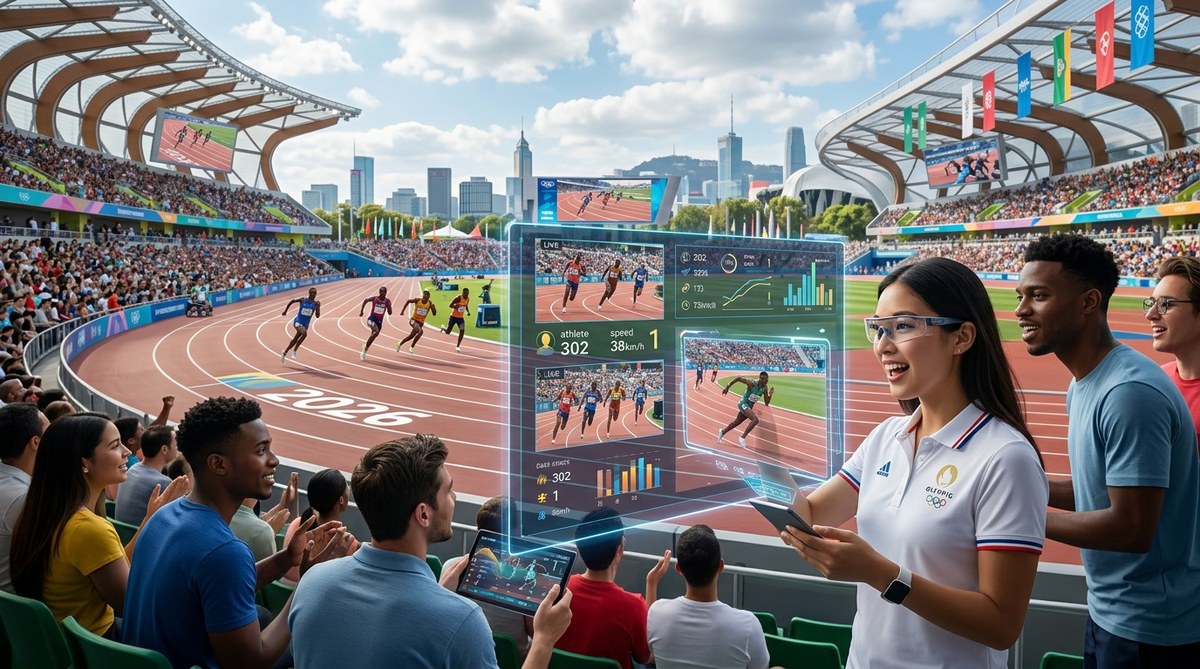
Broadcasters are testing a system called “volumetric capture.” Instead of a few dozen cameras, the LA Coliseum and other venues will be rigged with hundreds of tiny, high-speed sensors. These sensors feed data into an AI engine that reconstructs every moment in 3D space. You will not watch a replay. You will watch a full 3D simulation of the exact play from any angle you choose.
This is not a gimmick. It is a fundamental shift. Imagine a 100-meter sprint. Instead of one camera showing the finish line, you can rotate your view to see the runner’s face at the exact moment they break the tape. You can watch the race from above, from behind, or from the perspective of a coach standing on the track. The 2026 Summer Olympics impact on sports viewing means the viewer becomes the director.
How Personalization Changes Everything
The biggest change is not the technology itself. It is how that technology hands control to you. For the first time, the Olympic broadcast will feel like a custom experience.
Here is what that looks like in practice:
- Open the official Olympic app or a supported streaming platform.
- Select the event you want to watch.
- Choose your preferred camera angle from a list of options. These include standard wide, athlete POV, coach cam, and AI-generated “best moment” views.
- Set your notification preferences. You can get alerts for record-breaking attempts, medal ceremonies, or specific athletes you follow.
- The system learns your habits. If you always watch swimming from the underwater angle, it will default to that for you next time.
This level of personalization was impossible five years ago. The 2026 Summer Olympics impact on sports viewing makes it standard. You no longer have to sit through a diving replay from a boring side angle. You can watch the diver’s face from the moment they leave the platform until they hit the water. You control the story.
The Technology Stack Behind the Shift
You might wonder how this actually works. It is not magic. It is a combination of several mature technologies that are finally being combined.
- AI-driven camera arrays: Cameras are no longer operated by humans alone. AI tracks the action and adjusts focus, zoom, and angle in real time. It can predict where the ball will go and frame the shot before the athlete gets there.
- Edge computing: All this video data needs processing power. Instead of sending everything to a central server, processing happens at the venue. This cuts latency to near zero. You see the action as it happens, not two seconds later.
- Adaptive bitrate streaming: Your internet connection is not the same as your neighbor’s. The system adjusts video quality on the fly. You get 8K HDR if your connection supports it. You get 1080p if it does not. No buffering, no stuttering.
- Multi-platform synchronization: You can start watching on your TV, pause, and pick up on your phone without missing a frame. The 2026 Summer Olympics impact on sports viewing includes seamless transitions between devices.
| Technology | What It Does | Why It Matters for Viewing |
|---|---|---|
| Volumetric capture | Creates a 3D model of the action | Lets you choose any camera angle after the fact |
| AI camera tracking | Follows the action automatically | Eliminates shaky or missed shots |
| Edge computing | Processes video at the venue | Reduces delay to under 100 milliseconds |
| Adaptive streaming | Adjusts quality to your connection | No buffering, even on crowded networks |
| Multi-device sync | Keeps your place across screens | Watch anywhere without losing context |
What This Means for the Fan at Home
Let us be specific. You are sitting on your couch in Chicago. It is 2:00 PM on a Tuesday. You want to watch the women’s gymnastics floor final. In 2024, you had one feed. Maybe two if you had a second screen with a different angle.
In 2026, you open your streaming app. You see a menu of options. You pick “Athlete Focus” for the gymnast you have been following all year. The AI highlights every expression, every slight stumble, every triumphant look. You feel like you are standing on the mat with her.
Later, you watch the replay with your friends. You switch to “Judge’s View” to see the exact angle the judges saw. You argue about the score. You rewind and rotate the 3D model to see if her foot touched the line. The 2026 Summer Olympics impact on sports viewing turns every fan into an analyst.
“The biggest shift is not the resolution or the frame rate. It is the agency. Fans want to feel like they are part of the event, not just passive observers. When you give people control over their own perspective, engagement goes through the roof.” – Dr. Elena Torres, sports media researcher at USC Annenberg
The Streaming Battle That Changes Everything
The 2026 Summer Olympics impact on sports viewing also reshapes the business side. For years, the Olympics were a crown jewel for traditional broadcast networks. That monopoly is over.
Multiple platforms will carry the Games. You will see streams on Peacock, Amazon Prime, YouTube TV, and possibly even a dedicated Olympic app that aggregates everything. The old model of one network, one schedule, one set of commercials is dead.
This matters for you because it means choice. You are not forced to watch commercials for cars you do not want. You can pay for an ad-free tier. You can subscribe to just the events you care about. The 2026 Summer Olympics impact on sports viewing includes a pricing model that finally respects your time and your wallet.
- You can buy a full “All Access” pass for every event.
- You can buy a single-day pass for specific sports.
- You can pay per event, like a pay-per-view fight.
- You can watch free, with ads, on a basic tier.
This flexibility is new for the Olympics. It mirrors how younger fans already consume media. The 2026 Summer Olympics impact on sports viewing is a direct response to the way people watch YouTube, Twitch, and Netflix. The broadcast industry is finally adapting.
What Stays the Same and What Changes
Some things will not change. The emotion of a gold medal moment. The sound of a crowd roaring. The tension of a close finish. Technology cannot replace that.
But the way you experience those moments will be different. You will no longer be a passive observer. You will be an active participant in the broadcast. You will choose your own adventure.
Here is a quick breakdown of what shifts:
- From passive to active: You choose the camera. You choose the replay. You choose the data overlay.
- From one screen to many: Your TV, your phone, your tablet, and your smart glasses all work together.
- From scheduled to on-demand: Watch live or watch later. The entire library is available instantly.
- From generic to personal: The system learns your preferences and serves you the content you actually want.
The 2026 Summer Olympics impact on sports viewing is not about making the picture sharper. It is about making the experience smarter.
How to Prepare for the New Way of Watching
You do not need to buy a new TV today. But there are a few things you can do to make sure you get the most out of the 2026 Games.
- Check your internet speed. You will want at least 25 Mbps for a solid 4K stream. For 8K, aim for 50 Mbps or higher.
- Update your streaming devices. Older Roku sticks or Fire TVs may not support the new codecs. A 2025 or 2026 model will handle the load.
- Create an account on the official Olympic app now. Pre-load your preferences. Follow the athletes you care about.
- Test your multi-device setup. Make sure you can cast from your phone to your TV without issues.
- Talk to your friends about a watch party plan. The new tools are great for group viewing. Everyone can watch on their own device but share the same timeline.
If you want to understand the broader trends shaping this shift, check out our guide on top 10 emerging sports trends you need to watch in 2026. It puts the Olympic changes in context with what is happening across all of sports.
A New Era for Sports Fans
The 2026 Summer Olympics impact on sports viewing is not a small adjustment. It is a complete rethinking of what a broadcast can be. For the first time, the technology serves the fan instead of the other way around. You do not have to accept a bad camera angle. You do not have to miss a key moment because the director cut away. You do not have to sit through ads for things you do not care about.
This is the moment the sports viewing experience becomes truly personal. The Games will still be about athletic excellence. But the way you watch them will finally match the way you live your life: on your terms, on your devices, on your schedule. Get ready. It is going to be a very different kind of Olympic summer.