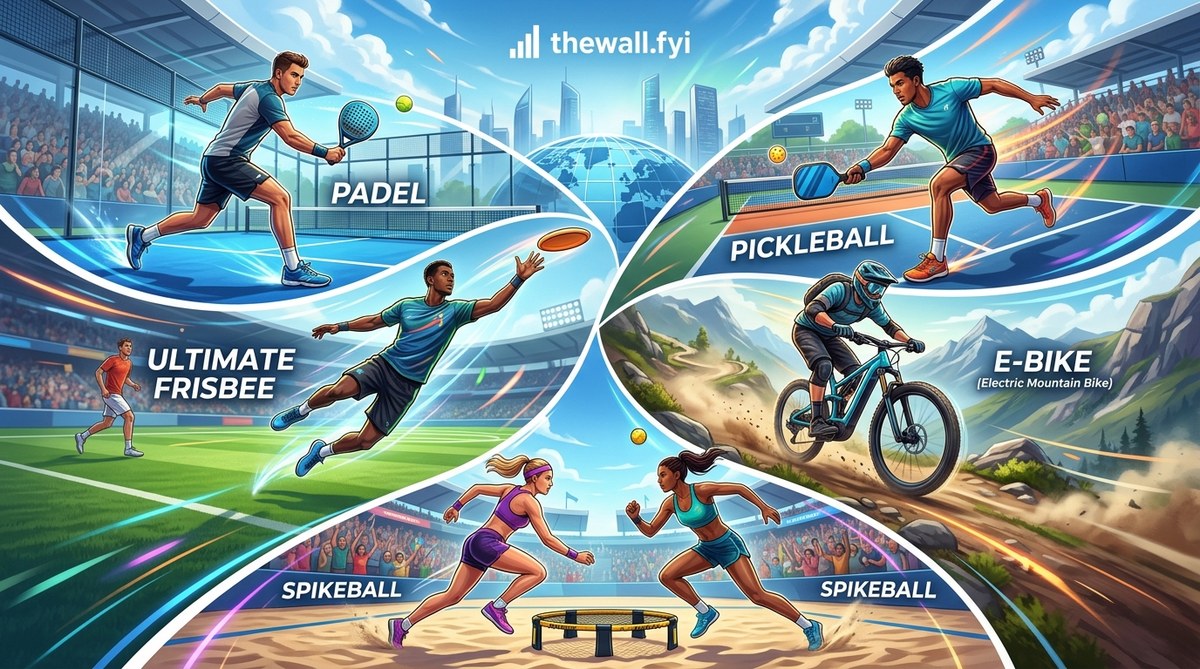
Remember when everyone started talking about pickleball? That wave is still going strong, but 2026 is bringing a fresh crop of niche athletic trends into the spotlight. Whether you are a sports enthusiast looking for your next hobby or a casual fan curious about viral movements, these five underrated sports have earned your attention. They aren’t just growing. They are exploding. Club memberships are up, tournament prize pools are rising, and social media feeds are filling with clips you have never seen before. Below are the most underrated sports exploding in popularity in 2026 and why you should care.
Five athletic niches are experiencing massive growth in 2026: padel, footgolf, spikeball, obstacle course racing, and disc golf. Each offers low barriers to entry, high social fun, and a strong community. Whether you want a workout, a new competitive outlet, or content to create, these sports deliver. Skip the mainstream and get ahead of the curve.
Some people think these sports are just fads. But the numbers tell a different story. Participation rates have doubled in the last two years across the United States. New facilities are opening every month. And the best part? You can start most of them this weekend with almost no experience.
Padel: The Tennis Cousin Taking Over
Padel looks like tennis played inside a glass cage. The court is smaller, the ball bounces off the walls, and the net is lower. It was huge in Spain and Argentina for decades. Now it is the fastest growing racket sport in America. In 2026 alone, over 500 new padel courts opened in the U.S. Cities like Miami, Los Angeles, and New York now have dedicated padel clubs that are packed every evening.
Why is padel exploding? Because it is easy to learn and extremely social. You do not need years of training to have a good rally. The walls keep the ball in play, so points last longer. That makes it more fun for beginners and more exciting for spectators. It is also a fantastic full-body workout without the high-impact stress of tennis on your knees.
Here are the main reasons people are switching to padel:
- Lower learning curve compared to tennis or squash
- Doubles format makes it naturally social (great for dates or group outings)
- Courts are smaller, so running is less intense but still burns calories
- Glass walls create dramatic, highlight-reel shots that go viral on TikTok
Padel is not just for amateurs either. Professional padel leagues are launching across the U.S., with prize money climbing each year. If you want to be part of the next big thing, this is where to start.
Footgolf: Soccer and Golf Combined
Footgolf is exactly what it sounds like. You kick a soccer ball into a giant hole on a golf course, and the player with the fewest kicks wins. It started as a novelty but has turned into a legitimate sport with its own professional tour. In 2026, the American Footgolf League reports that over 200 courses now offer footgolf layouts, many co-located with traditional golf courses.
The appeal is simple. You get the fresh air and strategy of golf without the expensive clubs and frustrating swing mechanics. All you need is a regulation soccer ball and some comfortable shoes. It is also much faster than a round of golf. A typical footgolf round takes about an hour and a half instead of four hours.
“Footgolf is the perfect bridge sport,” says Mike Simms, director of the US Footgolf Association. “It brings soccer players who never tried golf onto the course, and it attracts golfers who want a fun, low-pressure alternative. In 2026, we are seeing more families, corporate outings, and college clubs than ever before.”
The sport is also a natural fit for content creators. The long approach shots and dramatic putts (kicks) create shareable moments. And because it is still relatively new, there is less competition for views compared to golf or soccer.
Spikeball: The Beach Game That Went Collegiate
Spikeball, also known as roundnet, is the game where two teams of two hit a ball onto a trampoline-like net. The ball bounces up, and the other team must return it within three touches. It started on beaches and backyards. Now it has grown into a varsity-level sport at dozens of colleges across the United States.
The spikeball community is one of the most welcoming I have seen. Tournaments are held almost every weekend, and the professional circuit offers six-figure prize pools. The equipment is cheap (a set costs about 60 dollars), and you can play almost anywhere: grass, sand, gym floors, or even asphalt.
How to get started with spikeball in 2026:
- Buy a roundnet set (brands like Spikeball or Slammo work well).
- Gather three friends (or find players through local Facebook groups).
- Learn the basic rules: the ball must hit the net and bounce upward; you cannot catch or hold it.
- Practice serving and setting up your teammate for a spike.
- Join a local tournament (use the official Spikeball app to find events near you).
- Watch pro matches on YouTube to pick up advanced strategies.
Spikeball burns a lot of calories in a short time because the rallies are fast and require constant movement. It also builds reflexes and hand-eye coordination. And because the net folds up small, you can keep it in your car trunk for spontaneous games anywhere.
Obstacle Course Racing Is No Longer Just for Marines
Obstacle course racing, or OCR, covers events like Spartan Race, Tough Mudder, and Rugged Maniac. These races combine running with physical challenges: climbing walls, crawling under barbed wire, carrying buckets of rocks, and traversing monkey bars. In 2026, OCR has shed its niche image and become a mainstream fitness trend.
Race registrations are up 40 percent since 2024. New OCR-only gyms are opening in suburbs across the country. And the demographic is shifting. It used to be dominated by elite athletes and military veterans. Now you see moms, dads, office workers, and teenagers lining up at the starting corral.
What makes OCR different from other sports? It tests your whole body and your mental toughness. You never know what obstacles will appear. That uncertainty builds resilience, which is why many people use OCR as a tool for personal growth.
Below is a table comparing the main types of obstacle course races so you can pick the right one for your first try:
| Race Type | Typical Length | Obstacle Count | Best For | Common Mistake Beginners Make |
|---|---|---|---|---|
| Stadion (Spartan) | 5K | 20+ | Runners who want a short, intense challenge | Starting too fast and gassing out before the obstacles |
| Sprint (Spartan) | 5K | 20+ | First-timers looking for a true test | Forgetting to train grip strength (monkey bars are brutal) |
| Super (Spartan) | 10K | 25+ | Intermediate fitness levels | Wearing cotton clothes that get heavy when wet |
| Tough Mudder | 8-10 miles | 25+ | Teams who want a bonding experience | Trying to do everything solo instead of helping teammates |
| Rugged Maniac | 3.1 miles | 25+ | Beginners who want a fun, less intense vibe | Not wearing proper trail shoes |
The community in OCR is incredibly supportive. People will cheer you on and even help you over walls. That camaraderie keeps participants coming back season after season.
Disc Golf: The Free Sport That Is Everywhere
Disc golf is like regular golf, but you throw a Frisbee-like disc into a metal basket. It is one of the most accessible sports in 2026. Almost every city has at least one disc golf course, and most of them are free to play. You can buy a starter set of three discs for under 20 dollars. No tee times, no membership fees, no dress code.
The Professional Disc Golf Association now has over 100,000 active members, and that number is growing by 15 percent each year. Major tournaments are broadcast on ESPN and draw tens of thousands of live spectators. The sport is especially popular among young adults because it combines hiking with skill and strategy. It is also a great way to get outside and reduce screen time.
Disc golf has a steep skill curve, but the learning is addictive. You start by throwing your discs into trees and bushes. Within a few rounds, you learn to shape your throws and read the wind. Local clubs are always welcoming to newcomers, and many courses have league nights every week.
Get Ahead of the Curve in 2026
These five underrated sports are not just flashes in the pan. They are building real infrastructure, real communities, and real careers. Whether you choose to play padel on a glass-walled court, kick a soccer ball around a footgolf course, spike a ball on a trampoline net, crawl under barbed wire in an OCR race, or throw discs in a park, you are joining a movement that is only going to get bigger.
The best time to start something new is when it is still small enough to feel like a secret. 2026 is that moment for these sports. Gather a friend, pick one that excites you, and give it a shot. You might discover your next obsession.
For more on the shifting landscape of athletics, check out our guide to top 10 emerging sports trends you need to watch in 2026. And if you want to train smarter, read about how technology is revolutionizing athlete training and performance.