You have decided to stop paying for a commercial gym membership. Maybe you are tired of waiting for the squat rack. Maybe you want to train at 5 AM without driving anywhere. Maybe you just want a space that feels like yours. Building a home gym for peak athletic performance in 2026 is a smart move, but it can also be a costly mistake if you buy the wrong stuff. This guide walks you through every decision, from the floor up, so you end up with a training space that actually makes you faster, stronger, and more resilient.
The best home gym in 2026 is not the one with the most equipment. It is the one that removes friction from your training. Focus on a power rack, a barbell, weight plates, a cardio machine that matches your sport, and a dedicated recovery zone. Buy in phases. Prioritize floor protection and ventilation. Train with intent every session.
Start With Your Sport, Not Your Wish List
Before you buy anything, get clear on how you train. A powerlifter needs different gear than a marathoner. A CrossFit athlete has different needs than a recreational basketball player. Your home gym should serve your primary sport first.
Ask yourself these three questions:
- What is my main athletic goal for 2026? (Example: run a sub-4 hour marathon, add 50 pounds to my deadlift, improve my 40-yard dash time)
- What are the three exercises I do most often? (Example: bench press, squat, pull-ups)
- What equipment do I absolutely need to perform those exercises safely? (Example: a power rack with safeties, an adjustable bench, a barbell)
Once you answer those, you have a buying list. Ignore everything else until you have those items.
A lot of people fill a garage with expensive machines they use twice. Do not be that person. If you are a runner, your first purchase should be a high-quality treadmill or an air bike for cross-training. If you are a strength athlete, start with a power rack and a barbell. If you play a sport that demands explosive power, add a plyo box and a sled.
For more on how training is changing, read about the top 10 emerging sports trends you need to watch in 2026.
The Five Pillars of a High-Performance Home Gym
Think of your gym as having five zones. You do not need all five on day one, but you should plan for them.
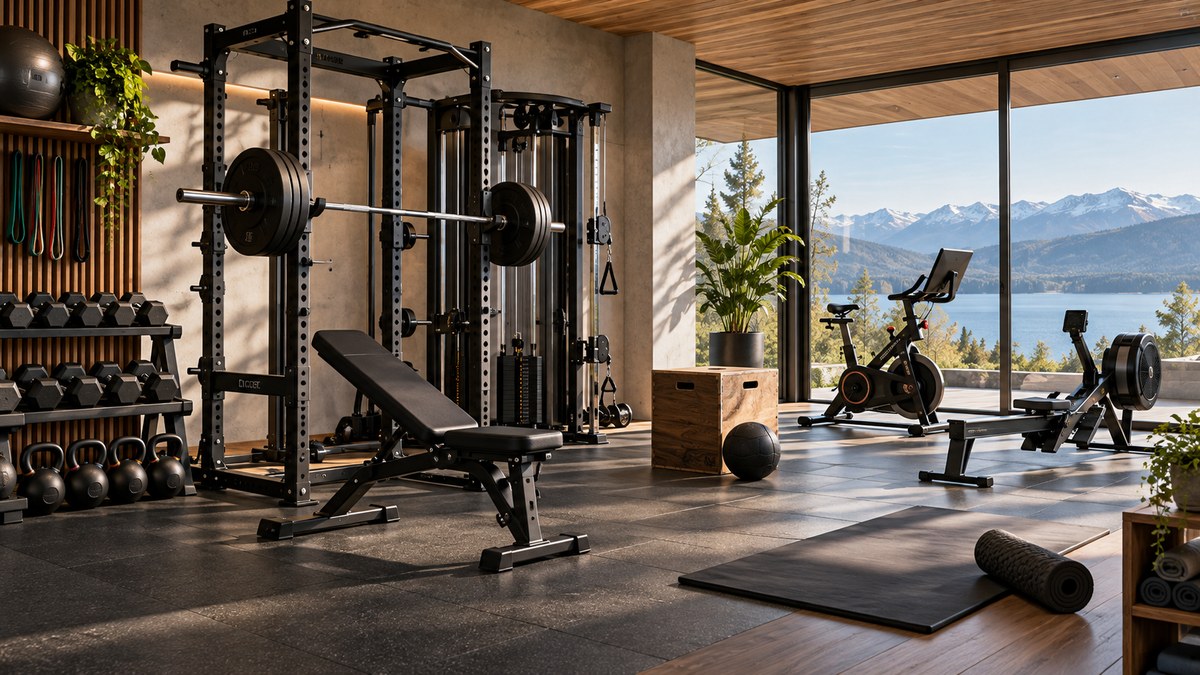
- Strength zone: Power rack, barbell, weight plates, adjustable bench, dumbbells.
- Cardio zone: Treadmill, rower, assault bike, or ski erg. Pick one that matches your sport.
- Mobility and recovery zone: Yoga mat, foam roller, lacrosse ball, massage gun.
- Explosive power zone: Plyo box, battle ropes, kettlebells, resistance bands.
- Storage and flooring: Rubber mats, wall-mounted racks, a fan, and good lighting.
Each zone should be clearly defined. Do not let your dumbbells live in the middle of your cardio space. That is how you trip and get hurt.
Phase Your Purchases Like a Pro
You do not have to spend $10,000 at once. In fact, phasing your purchases helps you avoid buying gear you never use. Here is a three-phase plan that works for most athletes.
Phase 1: The Foundation (Months 1-2)
– A power rack with safeties (this is non-negotiable for solo training)
– A quality barbell (do not buy the cheapest one; it will bend)
– A set of weight plates (start with 255 pounds total)
– An adjustable bench that can go from flat to 90 degrees
– Rubber flooring to protect your concrete slab
Phase 2: The Essentials (Months 3-4)
– A cardio machine (air bike or rower)
– A set of adjustable dumbbells (5-50 pounds)
– A pull-up bar or a rack attachment
– A plyo box (wooden or foam)
– Resistance bands for warm-ups and accessory work
Phase 3: The Finishing Touches (Months 5-6)
– A dedicated sound system or a good Bluetooth speaker
– A fan that moves serious air
– A wall-mounted TV or tablet holder for programming
– Recovery tools: foam roller, percussion gun, stretching straps
– Decor that motivates you (flags, photos, lighting)
Phasing keeps you from buying a $3,000 treadmill you hate. It also lets you learn your space. Maybe you realize you prefer kettlebells over dumbbells. That is fine. Adjust as you go.
Space Planning: Measure Before You Move
Your garage or spare bedroom is not an infinite warehouse. You need to measure everything.
- Measure the length, width, and height of your space. Write it down.
- Mark the ceiling height. You need at least 7.5 feet for overhead pressing. If you have less, you cannot do standing overhead presses safely.
- Identify where the door swings. Do not place equipment where it blocks entry or exit.
- Plan your power rack against the longest wall. Leave at least 3 feet of clearance on each side.
- Put your cardio machine near the door. That way you can air it out after a hard session.
A common mistake is putting the rack in the center of the room. That wastes floor space and makes you feel cramped. Push everything against walls. Keep the middle open for movement drills, stretching, or burpees.
If you are working with a tight space, look at foldable racks and wall-mounted solutions. Many brands now make racks that fold flat when not in use. That frees up room for parking your car or for other hobbies.
Equipment Selection: What to Buy and What to Skip
Not all equipment is worth your money. Here is a table to help you decide.
| Equipment | Buy It If… | Skip It If… |
|---|---|---|
| Power rack | You train alone and value safety | You always have a spotter and never fail reps |
| Barbell | You do any form of strength training | You only do bodyweight or band work |
| Adjustable dumbbells | You need variety without taking up space | You have room for a full dumbbell set |
| Treadmill | You are a runner or walk for cardio | You prefer cycling or rowing |
| Air bike | You want high-intensity conditioning | You hate being uncomfortable |
| Cable machine | You do a lot of isolation work | You are fine with bands and dumbbells |
| Smith machine | You are a beginner who wants safety | You want to build stabilizing muscles |
| Leg press machine | You have a specific rehab need | You can squat and deadlift safely |
In 2026, smart equipment is everywhere. Treadmills with live coaching, barbells with built-in tracking, and racks with digital safety catches are all available. But do not let the tech distract you. A basic barbell and a flat bench will still get you stronger than a smart machine you do not use.
For a look at how gear is evolving, check out 5 game-changing innovations in sports equipment you need to know for 2026.
Flooring and Ventilation: The Unsung Heroes
You can have the best rack in the world. If your floor is slippery and your room smells like a locker room, you will not train there.
Flooring
– Use 3/8-inch rubber mats for general weightlifting.
– Use 1/2-inch or 3/4-inch mats if you drop heavy deadlifts or Olympic lifts.
– Do not use puzzle mats unless you are doing yoga. They shift under heavy loads.
– Cover the entire floor, not just under the rack. Sweat and chalk get everywhere.
Ventilation
– Install a heavy-duty fan. A box fan is okay. A commercial floor fan is better.
– If you have windows, open them. If not, consider a portable air conditioner.
– A dehumidifier helps if your garage gets damp. Rusty plates are no fun.
Lighting
– Overhead LED lights are cheap and bright.
– Avoid fluorescent tubes. They flicker and can cause headaches.
– Add a dimmer switch if you want to set a mood for evening sessions.
Training Protocols for the Home Athlete
Your home gym is ready. Now you need a plan. Training alone requires discipline. Here are three protocols that work well in a home setting.
Protocol 1: The Heavy-Light-Medium Split
– Day 1 (Heavy): 5 sets of 5 reps on your main lift (squat, bench, deadlift)
– Day 2 (Light): Accessory work, mobility, and cardio
– Day 3 (Medium): 3 sets of 8 reps on your main lift, plus conditioning
– Repeat or adjust based on recovery
Protocol 2: The Circuit Finisher
– After your main work, do 5 rounds of:
– 10 kettlebell swings
– 10 push-ups
– 10 box jumps
– 30-second plank
– Rest 60 seconds between rounds. This builds work capacity.
Protocol 3: The Sport-Specific Session
– If you are a runner, do a 20-minute treadmill interval session after lifting.
– If you are a basketball player, do 10 minutes of jump rope and lateral hops.
– If you are a swimmer, focus on shoulder stability and core work.
“The best home gym is the one you use consistently. Do not overcomplicate your programming. Pick a simple plan and stick with it for eight weeks before changing anything.” – Mike B., strength coach and home gym builder since 2019
Common Mistakes That Kill Your Progress
Avoid these errors. They waste money and time.
- Buying a cheap barbell. A $150 barbell will bend within a year. Spend at least $300 on a reputable brand.
- Ignoring ceiling height. You cannot overhead press if the bar hits the ceiling. Measure twice.
- Skipping safeties. If you train alone, safeties can save your life. Do not skip them.
- Overloading on machines. A leg extension machine takes up space and does less than a squat.
- Forgetting about storage. Loose plates on the floor are a tripping hazard. Get a plate tree.
- Not planning for sound. A garage gym echoes. Earplugs or a good speaker help.
- Training without a log. Write down every set and rep. It keeps you accountable.
For more on staying healthy while training hard, read how to prevent common running injuries in 2026.
The Role of Recovery in Your Home Gym
Peak athletic performance does not come from training alone. You need to recover. Your home gym should include a recovery corner.
- A foam roller for your quads, hamstrings, and back.
- A lacrosse ball for your glutes and shoulders.
- A stretching strap for hamstring flexibility.
- A massage gun for post-workout relief.
- A cold plunge tub if you have the space and budget.
Recovery is not optional. It is how you stay consistent. If you are sore and tight, you cannot train hard. Build recovery into your routine, not as an afterthought.
Learn more about why cold plunging is the new recovery secret for elite athletes.
Your Home Gym, Your Rules
The ultimate home gym in 2026 is not about impressing anyone. It is about creating a space where you can do the work. You do not need a $5,000 cable machine or a wall of mirrors. You need a rack, a barbell, some plates, a cardio option, and the discipline to show up.
Start with the foundation. Phase in the rest. Keep your space clean and ventilated. Train with a plan. Recover like an athlete.
You have everything you need. Now go build it.