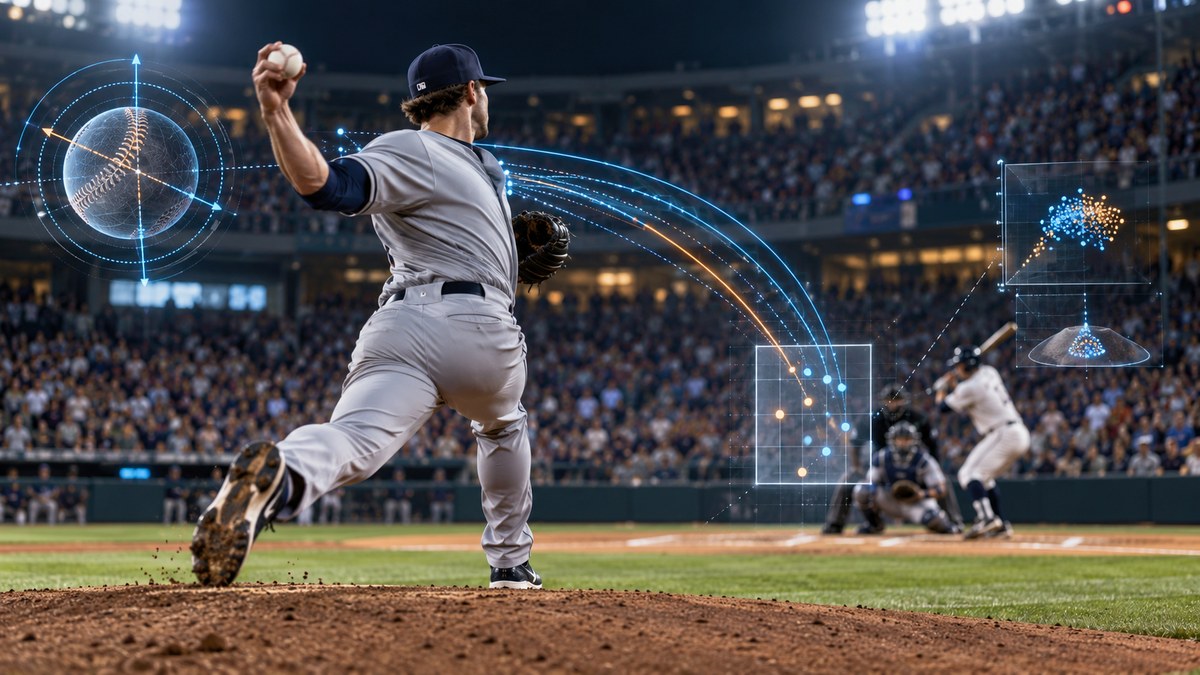
Baseball has always been a game of adjustments. For over a century, the duel between pitcher and hitter relied on gut instinct, a sharp eye, and a well-worn scouting report. That era is ending. In 2026, the mound belongs to the machines as much as it belongs to the arm. Artificial intelligence is rewriting how teams build pitch sequences, manage fatigue, and counter modern hitters who feast on mistakes. The 2026 MLB season will be defined by AI powered pitching strategies that turn raw data into a tactical weapon. If you follow the sport closely, you already sense the shift. The question is not whether AI will change pitching. The question is how much of an edge it will give the teams that adopt it first.
The 2026 MLB season will be defined by AI pitching strategies that optimize pitch selection, prevent injury, and exploit hitter weaknesses in real time. Teams using machine learning models gain a measurable edge in sequencing, recovery, and biomechanics. This guide breaks down exactly how AI changes the pitcher’s craft and what it means for the game.
What AI Brings to the Pitcher’s Mound
Traditional pitching strategy relied on a mix of scouting reports, pitch counts, and the catcher’s memory. A veteran pitcher might remember that a hitter chases low fastballs in the second at bat of a game. That knowledge is valuable, but it is also limited. Humans forget details. Humans get tired. Humans miss patterns hidden inside thousands of plate appearances.
AI does not have that problem. Machine learning models can process every swing a hitter has taken in the last three seasons, including data from spring training, exhibition games, and even the minor leagues. The model identifies tendencies that no human eye could catch. It sees that a hitter is 12 percent more likely to swing at a first pitch curveball after a called strike on a low zone fastball. That is the kind of micro pattern that wins at bats.
In 2026, every MLB team has access to this technology. The teams that use it best will have pitching staffs that look like they are reading the hitter’s mind.
How Teams Are Building AI Pitch Sequences
Building a game plan used to mean sitting down with a binder of printouts. Now it means running simulations. Here is the practical process that front offices and pitching coaches follow to create AI driven pitch sequences for the 2026 season.
-
Feed the model historical at bat data. The AI ingests every pitch type, location, velocity, and outcome from the last several seasons. It also learns from practice session data collected by wearable sensors on the pitcher’s throwing arm.
-
Run counterfactual simulations. The model asks: what if the pitcher throws a high zone curveball on the first pitch instead of a low zone fastball? It simulates the hitter’s response based on thousands of similar scenarios. The model ranks sequences by expected success rate.
-
Adjust for the pitcher’s current state. Wearable data from the pitcher’s warmup tells the model if the arm is slightly fatigued or if the shoulder rotation is off by two degrees. The sequence adjusts in real time to protect the pitcher and maximize effectiveness.
-
Deliver the sequence to the earpiece or smartwatch. The pitcher receives a recommended call for each at bat. The final decision stays with the human, but the recommendation is backed by millions of data points.
This process turns every at bat into a calculated decision rather than a guess. It is the difference between throwing a pitch and deploying a strategy.
The Pitfalls of Over Reliance on AI
AI is powerful, but it is not perfect. The 2026 season will also teach us where these systems fall short. Here are the most common mistakes teams make when they lean too hard on the machine.
| Common Mistake | Why It Fails | Better Approach |
|---|---|---|
| Ignoring the pitcher’s feel | The model cannot measure confidence or rhythm. A pitcher who feels a specific pitch working should trust that instinct. | Use AI as a guide, not a dictator. Let the pitcher override the call when something feels right. |
| Overfitting to past data | Hitters change. A model trained on 2024 data might miss a swing adjustment made in 2025. | Update models weekly during the season. Include recent at bats from the current campaign. |
| Neglecting environmental factors | Wind, humidity, and stadium altitude affect pitch behavior. Some models ignore these variables. | Layer weather data into the model. Use real time sensor data from the stadium. |
| Forgetting the mental game | Hitters know teams use AI. Some will try to bait the system by swinging at unusual counts. | Build deception layers into the sequence. Randomize calls to prevent pattern recognition. |
How Biomechanics Data Changes Training
AI does not just help during the game. It transforms how pitchers train between starts. In 2026, wearable sleeves and motion capture cameras track every angle of a pitcher’s delivery. The data flows into a model that identifies inefficiencies in the kinetic chain.
For example, a pitcher might be leaking power because their lead leg does not rotate fully during the follow through. The model spots that flaw and suggests a specific corrective drill. Over a month of training, the pitcher reduces stress on the elbow while adding two miles per hour to the fastball.
This is not theory. Several teams in the league have already reported lower injury rates among pitchers who train with AI guided biomechanics feedback. The technology is especially valuable for younger arms who are still developing their mechanics. For a deeper look at how technology is changing athletic preparation, check out how technology is revolutionizing athlete training and performance.
What the Data Tells Us About Hitter Weaknesses
The real magic of AI pitching strategies comes from understanding the hitter at a granular level. Here are some of the signals that machine learning models use to find weaknesses.
- Pitch location bias. Some hitters struggle with high zone pitches when the count is even. Others chase low zone pitches on odd counts. The model finds these patterns even if the hitter does not know they have them.
- Velocity sensitivity. A hitter might crush a 95 mph fastball but flail at a 78 mph curveball with similar placement. The model identifies the speed window where the hitter is most vulnerable.
- Sequencing memory. Hitters remember what they saw last at bat. The model predicts which sequences break the hitter’s rhythm by avoiding repetition.
- Countdown pressure. Some hitters become more aggressive as the count increases. The model recognizes when to waste time and when to attack early.
These insights let the pitcher control the at bat before the ball leaves their hand.
A Coach’s Perspective on AI Integration
“The best pitchers in 2026 will be the ones who treat AI like a second set of eyes, not a replacement for their instincts. I have seen guys try to follow the model blindly, and they get ripped apart when the hitter adjusts. The model gives you a 70 percent solution. The other 30 percent is feel, experience, and the ability to read a hitter’s body language in the moment. Never let the machine take that away from you.” — Anonymous MLB Pitching Coach
That quote captures the balance every team is trying to strike. AI is a force multiplier, but it cannot replace the human element that makes baseball beautiful.
The Arms Race in Pitch Selection
As more teams adopt AI pitching strategies, the league is entering an arms race. The teams with the best data pipelines will have an advantage, but that advantage will shrink as the technology becomes standard. By mid 2026, every team will have some form of AI assisted pitch selection. The differentiation will come from how well teams integrate the data with their coaching philosophy.
Some teams are already experimenting with generative models that create entirely new pitch sequences on the fly. These systems do not just recommend existing pitches. They invent combinations that have never been thrown before. That is a wild concept for a sport that has used the same pitch types for decades. It is also a sign of where the game is heading.
If you want to see which broader trends are shaping the sports world this year, take a look at top 10 emerging sports trends you need to watch in 2026.
What This Means for the 2026 Season
The 2026 MLB season will not be the year that robots replace pitchers. It will be the year that pitchers who embrace AI gain a measurable edge over those who do not. The gap between a team using a basic model and a team using a fully integrated system could be worth several wins over a season. In a league where playoff spots are decided by a few games, that margin matters.
For the fan watching from the stands or at home, the changes will be subtle. You will not see a pitcher staring at a screen before every throw. You will just see better pitching. More called strikes. Longer counts. Fewer barrels. The game will look the same, but the thinking behind it will be radically different.
Your Next Step as a Data Driven Fan
If you are a baseball analyst, a sports tech enthusiast, or just a fan who loves the strategy behind the game, now is the time to pay attention. Watch how teams talk about their pitching staff this season. Listen for mentions of data models, wearable feedback, and sequence optimization. The teams that are open about their AI use are the ones betting big on this approach.
You can start building your own understanding by following the work of analysts who publish model driven breakdowns. Pay attention to how pitch selection changes from game to game. Notice when a pitcher seems to know exactly what the hitter is expecting. That is the AI at work.
The 2026 season is going to be a masterclass in how artificial intelligence can enhance a centuries old craft. It will also be a reminder that the best technology is the one you barely notice. So grab your notebook, pull up a game, and start watching the mound with fresh eyes. The future of pitching is already here.