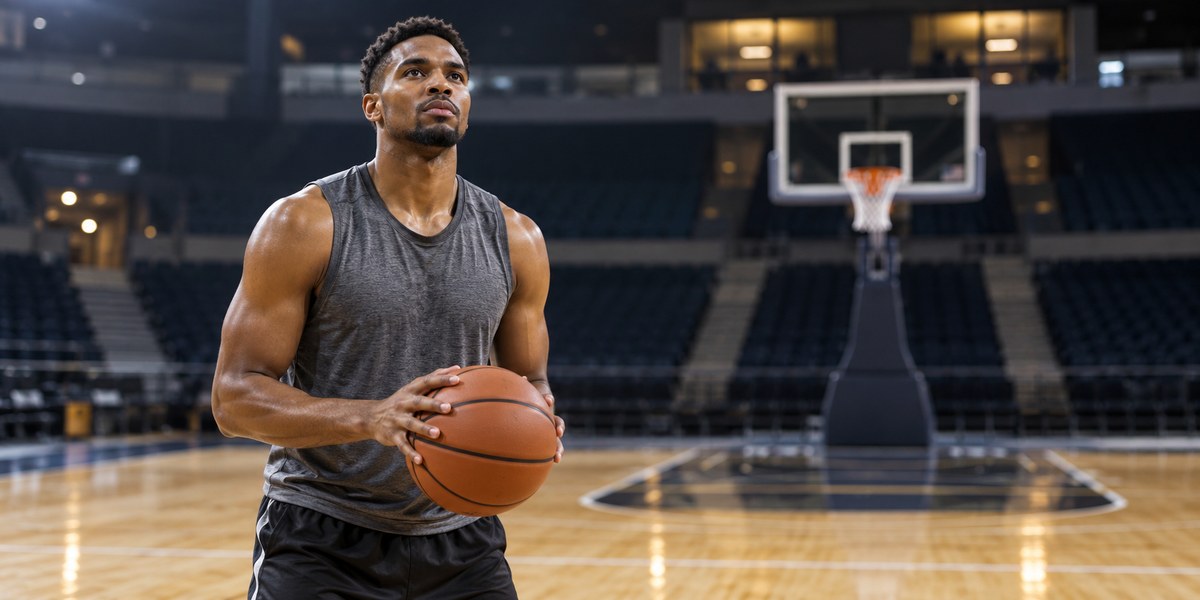
You step to the line. The game is on the line. Your heart thumps against your ribs. You take a breath, but it’s shallow, rushed. The ball leaves your hand, and you already know it’s off. That feeling of helplessness when a free throw clanks off the rim is frustrating. It’s also fixable. Most players focus only on their shooting form, but they ignore the system that controls that form: the nervous system. The missing piece is often something you do thousands of times a day without thinking. Breathing. When you learn to control your breath, you control your heart rate, your muscle tension, and your focus. This is not theory. This is the science that top performers in every sport are using right now. If you want to improve free throw accuracy, you need to start with the air in your lungs.
Improving free throw accuracy is not just about arc and release angle. It is about calming the nervous system before the shot. A structured breathing technique, practiced daily, lowers heart rate and steadies the upper body. When combined with a simple three-step pre-shot routine, players can increase consistency by reducing the physical noise that causes misses.
Why Your Nerves Ruin Your Free Throws
Basketball is a sport of chaos. You sprint, you jump, you fight through screens. Then, suddenly, you must be still. That transition from explosive movement to calm precision is brutally hard. Your sympathetic nervous system, the fight-or-flight mode, is still cranked up. Your breathing is fast and shallow. Your hands might shake. This is the enemy of a smooth free throw.
When your heart rate climbs above a certain threshold, fine motor control degrades. The small muscles in your wrist and fingers, the ones that control the release, become less responsive. You end up using bigger muscles to compensate, which leads to a jerky, inconsistent shot. The solution is not to try harder. The solution is to signal your body that it is safe to be calm. You do this with your breath.
The Breathing Technique That Changes Everything
The technique that has gained the most traction among sports psychologists and elite coaches in 2026 is called “Resonant Breathing” or coherent breathing. It is simple. You inhale for a count of five, and you exhale for a count of five. That is it. The magic happens in the pause between the breaths. By keeping the inhale and exhale equal, you create a rhythm that pulls your heart rate variability into a state of coherence. This is a fancy way of saying your heart and lungs start working in sync.
Here is how you apply it to a free throw.
- The Setup Breath. As you step to the line, take one resonant breath. Inhale through your nose for five seconds. Exhale through your nose for five seconds. Do not rush this. Let your shoulders drop.
- The Lock-In Breath. As you receive the ball from the official, take a second breath. This time, inhale for four seconds. Hold it for one second. Exhale for five seconds. This longer exhale activates the vagus nerve, which tells your body to relax.
- The Execution Breath. As you begin your shooting motion, start a slow exhale. The ball should leave your hand at the very end of that exhale. This prevents your chest from being tight and locked up at the moment of release.
This three-step process takes less than ten seconds. It is a ritual. Rituals work because they give the brain a predictable pattern, which reduces anxiety.
Common Mistakes Players Make at the Line
Many players try to hold their breath during the shot. This is a mistake. Holding your breath increases thoracic pressure and creates tension in your neck and shoulders. That tension transfers directly into the shot. Another common error is taking one giant, panicked gulp of air right before the release. This floods the system with oxygen and can make you feel jittery.
The table below breaks down the differences between a nervous shot and a controlled shot.
| Element | Nervous Shot (No Breath Control) | Controlled Shot (With Breathwork) |
|---|---|---|
| Breathing | Shallow, irregular, or held | Rhythmic, deep, continuous |
| Heart Rate | Elevated, erratic | Lowered, steady |
| Muscle Tension | High in shoulders and neck | Relaxed, loose upper body |
| Focus | Wandering, distracted by crowd | Locked on the rim |
| Release | Jerky, forced | Smooth, natural follow-through |
| Outcome | Low percentage, unpredictable | High percentage, repeatable |
A Drills Routine to Lock in the Skill
Knowing the technique is not enough. You must train it until it becomes automatic. The best time to practice this is when you are already tired, because that is when your breathing gets sloppy. Here is a short routine you can add to the end of any practice session.
- Stationary Breathing Drills. Stand at the free throw line without a ball. Go through the three-step breathing sequence ten times. Focus only on the rhythm. Do this for two minutes.
- The 5-Ball Challenge. Shoot five free throws in a row. Use the breathing sequence for every single shot. If you miss one, you start the count over. This builds mental pressure and forces you to use the breath even when you are frustrated.
- Tired Shooting. Run a full-court sprint or do twenty jump squats. Immediately step to the line and shoot. Your heart rate will be high. Use the resonant breath to bring it down before you shoot. This mimics game conditions.
- Eyes Closed Practice. Stand at the line. Close your eyes. Take three resonant breaths. Open your eyes and shoot immediately. This trains your body to find the calm state without visual distraction.
“The best shooters I have coached do not have perfect form. They have perfect composure. They can drop their heart rate by ten beats in six seconds. That is a superpower. Breathing is the only tool that gives you that power.” – Coach Marcus Bell, Sports Performance Specialist.
How to Track Your Progress
You cannot improve what you do not measure. Keep a simple shooting log. Record how many free throws you make out of ten during your warm-up. Then, after a week of using the breathing technique, record the same number. Look for trends. You are not looking for a perfect game. You are looking for a reduction in the number of bad misses. A miss that hits the rim is closer than an airball. That is progress.
You should also pay attention to the feel of your shot. After a month of consistent breathing practice, you will notice that your body feels quieter. The noise in your head during the shot will be lower. That is the sign that the technique is becoming a habit. For more on how the best athletes are using data to refine their training, check out how technology is revolutionizing athlete training and performance.
The Mental Side of the Free Throw
Breathing does not just fix the physical jitters. It fixes the mental loop. When you miss a free throw, the negative self-talk starts. “I am a bad shooter. I always choke.” That thought pattern triggers more stress, which makes the next shot harder. The breathing technique interrupts that loop. When you focus on the count, you cannot focus on the fear. You are present in the moment. This is a form of mindfulness, and it is why college athletes are turning to breathwork for a competitive edge in 2026.
Many players also struggle with the pressure of the crowd. The breathing ritual acts as a barrier. It creates a small bubble of focus around you. The noise of the gym fades away because your brain is busy counting. This is the same principle used by Navy SEALs and concert pianists. Control the input, control the output.
A Final Look at the Full System
To put everything together, here is a simple checklist you can use before every free throw in practice and in games.
- Stand tall. Feet shoulder-width apart.
- Take the first resonant breath (5 in, 5 out). Let your shoulders drop.
- Receive the ball. Take the second breath (4 in, 1 hold, 5 out).
- Begin your shooting motion. Start a slow exhale.
- Release the ball at the end of the exhale.
- Hold your follow-through. Do not drop your hands.
That is the entire sequence. It takes about eight seconds. It is a small investment of time for a massive return in consistency.
The Real Secret Nobody Talks About
The real secret to improving free throw accuracy is not about finding the perfect drill or the magic shooting sleeve. It is about removing the interference. Your body already knows how to shoot. You have done it thousands of times. The problem is that stress is scrambling the signal between your brain and your muscles. Breathing is the filter that cleans up that signal.
This approach works for any high-pressure situation. The same principle that helps a player sink a free throw helps a golfer sink a putt or a pitcher throw a strike. It is a universal tool. If you want to see how other sports are adopting similar mental and physical training methods, take a look at 5 essential recovery techniques every athlete should know in 2026.
Your First Step Tonight
You do not need a gym to start. Tonight, before you go to sleep, sit on the edge of your bed. Set a timer for two minutes. Breathe in for five seconds. Breathe out for five seconds. Do not skip a single breath. That is it. That is your first practice session. Do that for one week. Then, the next time you step on the court, use the same rhythm before you take your first shot. You will notice the difference immediately. The ball will feel lighter in your hands. The rim will look bigger. That is not magic. That is physiology. Use it.
This is the year you stop being a streaky shooter. This is the year you become reliable. It starts with a single, slow breath. Take it.