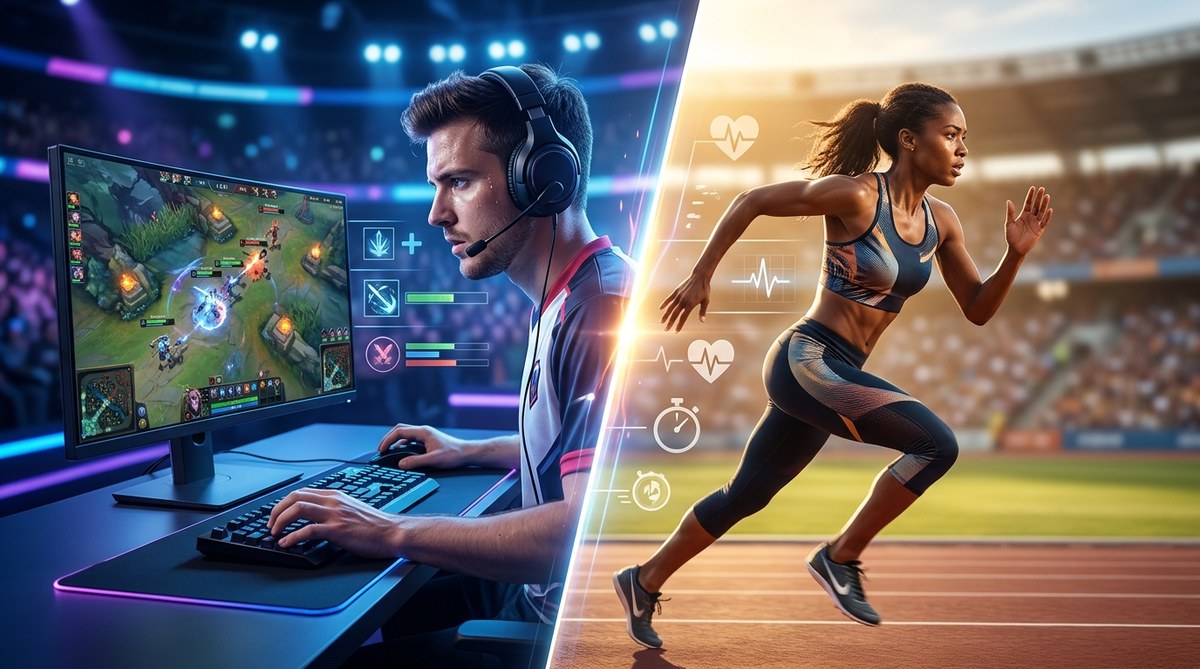
The crowd inside the Los Angeles Convention Center holds its breath. On a massive screen, two players face off in the final moments of a Street Fighter 6 match. Their fingers move faster than most people can see. Heart rates spike. Sweat drips down temples. When the victor raises his hands, the roar from 10,000 fans is deafening. This scene raises a question that refuses to go away: are esports athletes real athletes? In 2026, with Olympic trial events officially on the calendar and major sports federations taking sides, that question matters more than ever.
The debate over whether esports players qualify as athletes is intensifying in 2026, with Olympic trials on the horizon and many major sports organizations weighing in. This article examines both sides of the argument, from the intense physical and mental demands of competitive gaming to traditional definitions of athleticism rooted in physical exertion. Whether you are a gamer, sports fan, or journalist seeking clarity, this breakdown covers key points and evolving perspectives on the topic.
What Does It Mean to Be an Athlete?
The word "athlete" comes from the Greek "athletes," meaning one who competes for a prize. That definition is broad. But over time, our culture has attached extra meaning to the word. We tend to picture someone who runs, jumps, lifts, or throws. Someone whose body moves through space in a way that demands strength, speed, or endurance.
Traditional sports organizations have their own definitions. The International Olympic Committee defines a sport as an activity that involves physical exertion, skill, and competition governed by rules. The European Sports Charter says a sport must involve physical activity. The NCAA has its own criteria.
Here is where the debate gets tricky. Competitive gaming clearly involves skill and competition governed by rules. But does it involve enough physical exertion to count? That depends on who you ask.
In 2026, several major sports bodies have already changed their stance. The Asian Games included esports as a medal event in 2022 and again in 2026. The Olympic Esports Series launched in 2023 and continues to expand. These developments suggest that the definition of "athlete" is not as fixed as some people believe.
The Physical Side of Competitive Gaming
When people watch esports on a screen, they only see the game. They do not see what happens inside the player's body. Professional esports competitors experience physical demands that are real and measurable.
Consider the following physical elements of high level competitive gaming:
- Hand-eye coordination that must be precise to within milliseconds
- Finger dexterity and fine motor control that rivals that of concert pianists
- Sustained heart rates between 120 and 160 beats per minute during key matches
- Reaction times that average 100 to 150 milliseconds, faster than most traditional athletes
- Physical stress from long practice sessions (8 to 12 hours daily) that strains wrists, hands, back, and eyes
- Elevated levels of cortisol and adrenaline during tournament play
Research from the University of Wurzburg found that professional League of Legends players had heart rate responses similar to those of race car drivers during competition. Their motor skills were on par with professional musicians. These are not people sitting lazily on a couch. They are performing finely tuned physical actions under intense pressure.
The injuries tell the story too. Esports players suffer from repetitive strain injuries, carpal tunnel syndrome, tendonitis, and vision problems. These are the same types of overuse injuries seen in athletes who repeat specific motions thousands of times. If the physical toll looks like an athlete's toll, at what point does the label apply?
Training Like a Pro: What Esports Players Actually Do
A common misconception is that esports players just play video games all day. The reality is far more structured. Professional training regimens in 2026 look a lot like traditional sports training.
Here is a typical breakdown of what a pro esports athlete does each week:
| Training Component | Traditional Athlete (Tennis) | Esports Athlete (Valorant) |
|---|---|---|
| Practice hours per week | 25 to 35 | 40 to 55 |
| Physical exercise | Running, weight training, agility drills | Cardio, hand exercises, wrist stretches |
| Film / VOD review | 5 to 10 hours studying opponents | 10 to 15 hours reviewing match footage |
| Strategy meetings | Daily with coach and team | Daily with coach and team |
| Mental training | Sports psychology, visualization | Sports psychology, meditation, breathing drills |
| Recovery time | Massage, ice baths, sleep | Hand therapy, ergonomic adjustments, sleep |
| Competition frequency | Weekly tournaments or matches | Weekly scrims + monthly LAN events |
The table shows that esports professionals invest comparable or greater time into deliberate practice. They study opponents. They work with coaches. They train their bodies to handle the physical load. And they use the same mental preparation techniques that traditional athletes use.
One major difference stands out: esports athletes tend to practice more hours per week on average. This is partly because the competitive landscape changes fast, with game patches and meta shifts requiring constant adaptation. Traditional athletes also adapt to rule changes and opponent strategies, but the pace of change in esports can be more intense.
Why Some People Say Esports Is Not a Sport
Not everyone agrees with the comparison. Critics make several arguments that deserve respect.
The first argument is about physical exertion. Running a marathon, swimming laps, or playing a full soccer match demands cardiovascular output that sitting at a desk does not. Even if heart rates spike during key moments, the overall physical load is lower. Critics say a sport must require whole body movement and significant caloric expenditure.
The second argument is about tradition. Sports have a long history rooted in physical contests. Competitive gaming, critics argue, is a mental skill competition. They compare it to chess or poker, which are often called "mind sports" but rarely get the same status as football or basketball.
The third argument is about consistency. Not all video games require the same skills. A rhythm game like Guitar Hero demands different coordination than a strategy game like StarCraft. Critics say that if everything counts as a sport, then the word loses its meaning.
These are fair points. The question is whether they hold up under pressure.
How Esports and Traditional Athletes Compare
Let's put the two side by side across several dimensions.
| Dimension | Traditional Sports | Esports |
|---|---|---|
| Primary physical demand | Large muscle groups, cardiovascular endurance | Fine motor skills, hand-eye coordination, reflexes |
| Training structure | Team practice, film study, physical conditioning | Team scrims, VOD review, hand/wrist conditioning |
| Mental demand | Game strategy, pressure management, focus | Game strategy, pressure management, split-second decision making |
| Injury profile | Sprains, fractures, concussions, muscle tears | Carpal tunnel, tendonitis, eye strain, back pain |
| Career length | Typically 10 to 20 years | Typically 5 to 10 years |
| Prize money | Varies widely; top earners in millions | Varies widely; top earners in millions |
| Organizational recognition | IOC, NCAA, national federations | Growing recognition from IOC, Asian Games, some national bodies |
The comparison shows more overlap than many people expect. The biggest gap is in the type of physical demand. Traditional sports use the whole body. Esports relies on extremely refined actions from the hands, wrists, and eyes. The question is whether that difference disqualifies esports from the "athlete" label or whether it just represents a different kind of athleticism.
Some argue that archery and shooting are Olympic sports that rely primarily on fine motor control and mental focus. If those count as sports, why not competitive gaming?
Where the Olympic Trials Fit Into the Picture
The 2026 Olympic Esports Trials represent a turning point. For the first time, the International Olympic Committee has organized official trial events for competitive gaming. These trials are not just exhibitions. They follow IOC standards for athlete eligibility, anti doping rules, and competition structure.
This matters because the IOC has historically been slow to recognize new sports. The fact that they are running official trials signals a shift in how the highest authority in sports views competitive gaming.
In 2026, the trial events include games from multiple genres. Fighting games, first person shooters, and sports simulations are all represented. Players must qualify through regional tournaments. They must submit to drug testing. They must follow codes of conduct similar to those for Olympic athletes.
The IOC has been careful not to call esports players "Olympic athletes" just yet. The trials are a testing ground. But the trajectory is clear. If the trials succeed, full medal events could follow in future Olympic cycles.
This development puts pressure on the argument that esports is not a sport. If the Olympic system treats it like a sport, with the same rules and expectations, on what basis do we say otherwise?
A Practical Test: 3 Questions to Ask Yourself
If you are still trying to decide where you stand on this debate, these three questions can help clarify your thinking.
-
Does the activity require specialized training and skill? If you sat down to play a professional match tomorrow, could you compete? Probably not. Professional gamers spend years developing skills that most people do not have. They practice specific techniques, learn complex strategies, and develop muscle memory that takes thousands of hours to build.
-
Does the activity produce measurable physical responses? Check the data. Professional gamers have elevated heart rates during competition. They experience stress hormones. They suffer from physical injuries related to repetitive motion. Their bodies react to competition the same way traditional athletes' bodies do.
-
Does the activity have a competitive structure with rules, rankings, and organizations? Esports has all of these. There are professional leagues, world championships, ranking systems, coaches, analysts, and governing bodies. The structure mirrors traditional sports in almost every way.
If you answered yes to all three questions, you are probably in the camp that considers esports athletes to be real athletes. If you answered no to one or more, you have a consistent position that deserves consideration.
What the Experts Say
"People see us sitting in a chair and think we are not doing anything physical. But they do not see the hand speed, the reaction training, the hours of stretching and conditioning. I treat my body like an instrument. If I let my wrist health decline, I cannot compete. That makes me an athlete in my book."
— Jaedong "Jaedong" Lee, former StarCraft: Brood War world champion
This perspective from a legendary player highlights something important. The athletes themselves feel the physical toll. They take care of their bodies. They train with intention. The label matters to them, not for ego, but because it captures the reality of what they do.
Sports medicine professionals are also weighing in. Dr. Lindsey Migliore, a sports physician who works with esports organizations, has said that the physical demands of competitive gaming are real and that players should be treated as athletes for medical purposes. She points out that the injury patterns are different from traditional sports but no less serious.
The Conversation Is Changing
The debate over whether esports athletes are real athletes is not going to be settled by one article or one Olympic trial. It will be settled over time as more people see what professional gaming actually looks like.
In 2026, the conversation is already different from what it was five years ago. More schools offer esports scholarships. More insurance companies cover esports injuries. More parents see competitive gaming as a legitimate career path. These changes suggest that the definition of "athlete" is expanding rather than staying fixed.
For the curious fan or journalist, the best approach is to watch a professional match with fresh eyes. Pay attention to the players' hands, their breathing, their reactions. Notice the structure around them. Notice the preparation. Then decide for yourself.
The label may matter less than the respect. Whether you call them athletes or not, the people who compete at the highest level of esports have earned recognition for their skill, dedication, and sacrifice. As the Olympic trials continue and the world watches, one thing is certain: the definition of what it means to be an athlete is growing.
If you want to stay up to date on this topic, check out our coverage of the rise of virtual sports and esports and the top emerging sports trends to watch in 2026. You might also find our piece on how technology is revolutionizing athlete training useful for understanding the bigger picture.
The next time someone asks you "are esports athletes real athletes," you will have the facts, the context, and the nuance to give a thoughtful answer. And that is a win no matter which side you lean toward.